The number, and the line nobody warns you about
Quick answer: DSCR loan closing costs usually run 2 to 5 percent of the loan. On the Las Vegas purchase below, a 309,000 dollar loan closes at 12,064.32 dollars, or 3.90 percent. Clark County then adds transfer tax at 2.55 dollars per 500 of value, worth 2,101.20 dollars, taking the total to 14,165.52. The procedural surprise matters more. A rental loan is business credit, so neither a Loan Estimate nor a Closing Disclosure applies, and the federal fee protections most buyers rely on are absent.
Investors shop the rate and the down payment, then meet the fee sheet three days before signing. On a debt service coverage ratio loan that order is backwards. The file you are closing isn't a consumer mortgage, so it doesn't carry the consumer mortgage paperwork. There is no standardized form to compare. There is no legal tolerance if a number moves. What there is instead is a term sheet, a settlement statement, and whatever arithmetic you do yourself.
So this page does the arithmetic. It itemizes a real Las Vegas purchase line by line. Then it separates the charges you can move from the ones Nevada statute fixes, and works out which single negotiation earns the most. Every county figure comes from Clark County's own published fee schedule, or from the statute behind it. This page recomputes every total rather than quoting one.
Key takeaways
- 3.90 percent of the loan, before the transfer tax. The worked file closes at 12,064.32 dollars on a 309,000 dollar loan. Add Clark County's transfer tax and it is 14,165.52 dollars, or 4.58 percent. Both sit inside the 2 to 5 percent band everyone quotes, and now you can see where in it.
- No Loan Estimate arrives, and that is legally correct. Regulation Z exempts business-purpose credit at 12 CFR 1026.3(a)(1) and RESPA follows at 12 CFR 1024.5(b)(2). The Loan Estimate and Closing Disclosure live at 12 CFR 1026.19(e) and (f), which reach consumer transactions only. No three-day review window, and no fee tolerances either.
- Clark County charges 2.55 dollars per 500 dollars of value, or fraction thereof. That is 1.25 under NRS 375.020 plus 1.30 under NRS 375.023. On 412,000 dollars it is 2,101.20. Nudge the price 100 dollars higher and the fraction rounds up, so the tax rises 2.55 dollars on 100 dollars of price.
- The transfer-tax clause outranks the fee negotiation. That 2,101.20 dollars is larger than the title policy, the escrow fee and both recordings combined, which total 1,884.00 dollars. NRS 375.030(2) makes buyer and seller jointly liable whatever the contract says, so read the clause before you argue about an underwriting fee.
- Nevada title and escrow charges come off a filed public schedule. Under NRS 692A.120(5) a title agent may not charge outside the schedule filed with the Commissioner, and NRS 692A.130(1) says that schedule must be published. Ask for it. Then spend your negotiating effort on the lender's side, which is 6,780.00 dollars of the total here.
What do DSCR loan closing costs actually add up to?
They add up to roughly 2 to 5 percent of the loan amount. The honest version of that answer names where in the range your file lands, and why. So here is one complete file rather than a range.
Take a single-family rental in the Las Vegas valley at a purchase price of 412,000 dollars with 25 percent down. The down payment is 103,000 dollars and the loan is 309,000 dollars. Every figure below is an illustrative assumption except the two county lines, which are Clark County's own published numbers. No loan interest rate appears anywhere on this page, so the per-diem below carries a dollar amount instead.
Where the money actually sits
The file, line by line
| Line | Basis | Amount |
|---|---|---|
| A. Lender charges | ||
| Origination, 1.5 points | 1.5 percent of 309,000 | 4,635.00 |
| Underwriting and processing | Flat | 1,295.00 |
| Appraisal with Form 1007 rent schedule | Third party, ordered by the lender | 700.00 |
| Credit and background | Flat | 150.00 |
| Subtotal A | 6,780.00 | |
| B. Title, escrow and county | ||
| Lender's title policy | Filed schedule, NRS 692A.120 | 1,150.00 |
| Escrow and settlement, buyer's share | Filed schedule, NRS 692A.120 | 650.00 |
| Recording, 2 documents at 42.00 | Clark County Recorder fee schedule | 84.00 |
| Real property transfer tax | 824 increments at 2.55 | 2,101.20 |
| Subtotal B | 3,985.20 | |
| C. Prepaids and reserves | ||
| Prepaid interest, 12 days at 60.86 | Days remaining in the closing month | 730.32 |
| Landlord policy, 12 months paid at closing | Annual premium | 1,620.00 |
| Tax reserve, 3 months at 215.00 | Impound setup | 645.00 |
| Insurance reserve, 3 months at 135.00 | Impound setup | 405.00 |
| Subtotal C | 3,400.32 | |
| Total excluding transfer tax | 3.90 percent of the loan | 12,064.32 |
| Total including transfer tax | 4.58 percent of the loan | 14,165.52 |
What that means for the check you actually write
Closing costs aren't the whole ask. Add the down payment and you get cash to close, which is the number that decides whether the deal happens this month or next.
Cash to close, seller pays the transfer tax. 103,000.00 plus 12,064.32 is 115,064.32 dollars.
Cash to close, you agreed to pay it. 103,000.00 plus 14,165.52 is 117,165.52 dollars.
The gap. 2,101.20 dollars, decided entirely by one line in the purchase contract.
Notice how the total behaves. Lender charges scale with the loan, county charges scale with the price, and prepaids scale with the calendar. Consequently a bigger down payment shrinks the lender side and leaves the county side untouched, which is why the percentage moves around so much between files. Want the same arithmetic against the ratio itself? The Las Vegas DSCR calculator takes the payment side. Meanwhile how much you need to put down takes the equity side.
Want this itemized for your actual property?
Send the address, the price and the structure you have in mind. You get the fee sheet broken out the way this page breaks it out, with the Clark County lines computed from your recorded price rather than estimated. Current as of September 6, 2026.
Get your fast quoteWhy does no Loan Estimate arrive on a DSCR loan?
Because the loan is business-purpose credit, and the Loan Estimate is a consumer form. That single fact separates closing a DSCR file from closing the mortgage on your own house. Almost nothing written about DSCR closing costs mentions it.
The chain runs through three regulations. First, Regulation Z exempts business credit outright. The served text of 12 CFR 1026.3(a)(1) exempts an extension of credit primarily for a business, commercial or agricultural purpose. Second, the Official Interpretations remove any argument about which side of the line a rental sits on. Comment 3(a)-4 deems credit extended to acquire, improve or maintain non-owner-occupied rental property to be for business purposes. The number of housing units makes no difference. Third, RESPA follows Regulation Z. 12 CFR 1024.5(b)(2) exempts business purpose loans by pointing straight at the Regulation Z definition.
Now look at where the two forms actually live. 12 CFR 1026.19(e)(1)(i) requires the Loan Estimate in a closed-end consumer credit transaction secured by real property. 12 CFR 1026.19(f)(1)(i) requires the Closing Disclosure in a transaction subject to that same paragraph. A business-purpose loan is not a consumer credit transaction, so neither requirement reaches it.
What you give up, stated precisely
Three protections disappear together, and they are worth naming individually.
- The three-business-day review window. On a consumer mortgage, 12 CFR 1026.19(f)(1)(ii)(A) requires you to receive the Closing Disclosure no later than three business days before consummation. On a DSCR file there's no such deadline, and final numbers can land the day before signing.
- Zero tolerance on lender fees. Under 12 CFR 1026.19(e)(3)(i) a disclosed closing cost counts as good faith only when the final charge does not exceed the disclosed one. That rule doesn't reach this file. So a lender fee that grows between the term sheet and the settlement statement breaks nothing.
- The 10 percent aggregate tolerance. 12 CFR 1026.19(e)(3)(ii) caps the growth of recording fees, and of charges for third-party services where the creditor let the consumer shop and the provider is not an affiliate, at 10 percent in aggregate. Narrower than it sounds, and also gone.
Working without the form
What to do instead, since the form is not coming. Ask for a written, itemized fee sheet at the term-sheet stage rather than at clear-to-close. Ask for it in the same three buckets the table above uses. Then hold the escrow company's estimated settlement statement next to it and reconcile line by line yourself. The reconciliation takes about fifteen minutes and it's the only tolerance check that exists on this kind of file. Then read what a DSCR file has to show, so you raise the fee questions and the document questions in one conversation.
The one protection that does survive
One boundary matters here, and it cuts the other way. Regulation Z steps aside, but Regulation B does not. The appraisal-copy rule at 12 CFR 1002.14 applies whether the credit is for a business purpose or a consumer one, which is why you are still entitled to a free copy of the appraisal on a DSCR file. It is scoped to credit secured by a FIRST lien on a dwelling, which a purchase money DSCR loan almost always is. Note the limit: 12 CFR 1002.14(b)(2) defines the dwelling as a structure of one to four units, so a five-unit-plus file sits outside it. The DSCR appraisal and rent schedule page works through that right, and through what to do when the rent opinion lands low.
Which DSCR closing costs can you actually move?
Roughly half of them, and the half isn't where most investors look. Sort the same file by who controls the number and the picture changes immediately.
| Bucket | Who sets it | Amount | Room to move |
|---|---|---|---|
| Lender charges | The lender, by quote | 6,780.00 | Real. Points, underwriting and processing are all quoted numbers. |
| Title and escrow | The filed schedule, NRS 692A.120(5) | 1,800.00 | Limited. The charge must follow the schedule filed with the Commissioner. |
| County recording and transfer tax | Nevada statute | 2,185.20 | None on the amount. The transfer tax is negotiable only as to who pays it. |
| Prepaids and reserves | The calendar and your carrier | 3,400.32 | Timing only. Close later in the month and prepaid interest falls. |
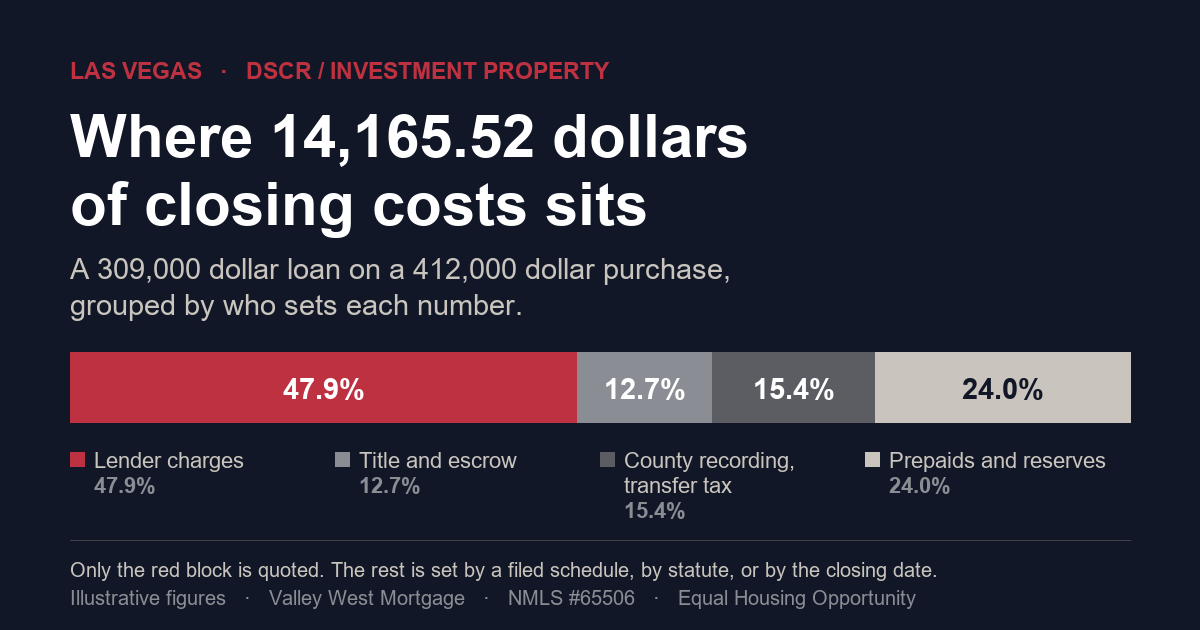
So 6,780.00 dollars out of 14,165.52 is genuinely quoted, which is 47.9 percent. Everything else is filed, statutory or arithmetic. Meanwhile the item most people never look at, the transfer-tax clause, is worth 2,101.20 dollars on its own.
The decision rule
Work the buckets in descending order of leverage, not in the order they appear on a statement. First, settle who pays the transfer tax. It's the largest single number you can influence, and it lives in the purchase contract rather than the loan file. Second, compare lender fee sheets, because that's where quoted numbers differ between lenders. Third, ask for the filed title schedule and confirm the charge matches it. Fourth, pick a closing date late in the month if cash is tight, which trims prepaid interest without changing anything else.
Notice what's missing from that list. Arguing about a 150 dollar credit fee is the most common negotiation and the least valuable one. It is 1.06 percent of the total.
What do Clark County's own numbers add?
Two lines, and both come straight from the county's published fee schedule rather than from an estimate.
Recording is 42.00 dollars per document. The Clark County Recorder's fee schedule states a fee per document of 42.00 dollars, and cites both NRS 247.305 and County Ordinance Title 2, Chapter 2.32. The statute is built in layers: a 25 dollar base in subsection 1(a), a further sum of up to 5 dollars the recorder may add under subsection 2, a mandatory 7 dollars under subsection 3, and up to 6 dollars the county commissioners may impose by ordinance under subsection 4. Use the county's published total rather than adding the layers yourself. A purchase records two documents, the deed and the deed of trust, so budget 84.00 dollars.
The real property transfer tax is 2.55 dollars per 500 dollars of value. The same schedule states that figure and cites NRS 375.020. The rate is built from two statutes rather than one. NRS 375.020(1)(a) imposes 1.25 dollars per 500 in a county whose population is 700,000 or more, which is Clark County. NRS 375.023(1) adds 1.30 dollars per 500 statewide. Together that is 2.55, which is exactly what the county publishes. Note also what does not apply: NRS 375.026 permits a further optional tax, but only in counties under 700,000, so it never reaches a Las Vegas purchase.
The fraction rule that surprises people
Both statutes tax each 500 dollars of value or fraction thereof. The count of increments therefore rounds up, never down, and the effect at a price boundary is abrupt.
At 412,000 dollars. 412,000 divided by 500 is exactly 824. The tax is 824 multiplied by 2.55, which is 2,101.20 dollars.
At 412,100 dollars. 412,100 divided by 500 is 824.2, which rounds up to 825. The tax is 2,103.75 dollars.
The lesson. 100 dollars of extra price cost 2.55 dollars of extra tax. A price that lands just over a 500 dollar boundary buys a full increment.
| Purchase price | Increments of 500 | Transfer tax |
|---|---|---|
| 325,000 | 650 | 1,657.50 |
| 375,000 | 750 | 1,912.50 |
| 412,000 | 824 | 2,101.20 |
| 450,000 | 900 | 2,295.00 |
| 525,000 | 1,050 | 2,677.50 |
| 650,000 | 1,300 | 3,315.00 |
Who pays the Nevada transfer tax, buyer or seller?
Whoever the purchase contract says, with one important caveat that the contract can't change.
Clark County custom puts the real property transfer tax on the seller, and most local purchase contracts follow the custom. That's a market convention rather than a legal allocation, and an investor buying from a seller with leverage, or buying at auction, or buying a new build, may well find the clause pointing the other way. Read it before you sign.
The caveat is NRS 375.030(2), which states that the buyer and the seller are jointly and severally liable for the tax and for any penalties and interest. So a private agreement decides who writes the check. It doesn't decide who the county can pursue if the tax turns out to be short. NRS 375.030(3) sets out what happens then: if the recorder later disallows a claimed exemption or determines more tax is due, and the additional amount is not paid within 30 days of notice, a 10 percent penalty attaches along with interest at 1 percent a month calculated from the original recording date.
That matters most on the transactions where an exemption gets claimed, which for investors usually means an entity transfer. More on that below.
Worth its own line On the worked file the transfer tax is 2,101.20 dollars, while the lender's title policy, the escrow fee and both recordings together come to 1,884.00 dollars. The clause deciding who pays the tax is therefore worth 217.20 dollars more than the entire title, escrow and recording section combined. Very few investors negotiate it, and almost everyone negotiates the underwriting fee.
Can you shop title and escrow in Nevada?
You can shop the provider. You can't shop below the filed rate, and Nevada is unusually explicit about this.
NRS 692A.120(1) requires each title insurer to file all of its rate schedules, schedules of charges and forms with the Commissioner. That list covers preliminary reports, binders, commitments and policies. Subsection 4 says no form or schedule may be used until the Commissioner approves it. Then subsection 5 does the real work. No title insurer or title agent may impose any charge for premium, escrow, settlement or closing services tied to a title policy, except in accordance with that filed schedule.
NRS 692A.130(1) completes the picture. Every title insurer and every title agent must print and make available to the public the schedule of fees and charges filed with the Commissioner.
How to use that
Ask for the filed schedule and check your quoted charge against it. That's a request the statute already anticipates, so it shouldn't be a difficult conversation. Two practical consequences follow. First, treat a title or escrow quote far below another as a reason to look twice rather than to celebrate. The charge should come off an approved schedule. Second, the title side is largely fixed, so spend your negotiating time on the lender's 6,780.00 dollars. Better still, spend it on the contract clause that moves 2,101.20 dollars in one edit.
Do points make sense against a prepayment penalty?
Sometimes, and the test is a date rather than a rate. This page quotes no interest rates, so work it in dollars, which is how the decision is actually made anyway.
One point on the worked loan is 1 percent of 309,000 dollars, so 3,090.00 dollars. Suppose buying that point lowers the monthly payment by 46 dollars. Breakeven is 3,090 divided by 46, which is 67.2 months, or 5.60 years. Below breakeven the point loses money. Above it, the point pays.
Now bring in the feature that makes a DSCR file different. Most of these loans carry a prepayment penalty, commonly stepping down over three or five years. Set the two clocks side by side and the decision becomes obvious.
Breakeven inside the penalty period. Say the point breaks even in 2.5 years and the penalty runs 3 years. You will almost certainly still hold the loan at breakeven, since leaving early costs you the penalty. The point is close to free optionality.
Breakeven after the penalty period. Breakeven at 5.60 years against a 3-year penalty is a different bet. You gain the right to refinance at year three. You don't reach breakeven until year five and a half. You're paying today for a benefit that starts after the moment you gain the right to walk away.
The rule. Buy points when breakeven lands inside the prepayment penalty period, because the penalty is already holding you there. Think much harder when breakeven lands beyond it. The mechanics of those penalties, including how the step-down structures differ, sit on the DSCR prepayment penalty page.
How does a DSCR refinance differ from a purchase?
It's meaningfully cheaper on the county side, and the reason is a definition rather than a discount.
NRS 375.010(1)(b) defines a deed as every instrument that conveys title to an estate or present interest in real property and vests it in another person. The statute then lists what the term excludes. Item (3) on that list is a deed of trust or common-law mortgage instrument that encumbers real property. A refinance records a new deed of trust and no deed conveying the property, so no taxable transfer occurs. The transfer tax line isn't reduced. It's simply absent.
| Line | Purchase | Rate and term refinance |
|---|---|---|
| Lender charges | 6,780.00 | 6,780.00 |
| Title and escrow | 1,800.00 | 1,800.00 |
| Recording | 84.00 (2 documents) | 42.00 (1 document) |
| Real property transfer tax | 2,101.20 | 0.00 |
| Prepaids and reserves | 3,400.32 | 3,400.32 |
| Total | 14,165.52 | 12,022.32 |
| Paid from | Your own funds at closing | Commonly financed into the balance |
The difference is 2,143.20 dollars, and 2,101.20 of it is the transfer tax alone. Note the last row, though, because it hides a cost that does not show up as a fee. Financing 12,022.32 dollars of costs raises the loan balance, which raises the payment, which lowers the coverage ratio on the very file being underwritten. Nothing left your bank account and the ratio still moved. If you're pulling cash out as well, the same trade compounds, and how a DSCR cash-out refinance works covers where that ratio pressure usually bites.
What changes when you close in an LLC?
The county charges don't change at all. The document list grows, and one Nevada exemption is worth planning around before you choose how to take title.
The paperwork
Closing in an entity typically means supplying the operating agreement, the articles of organization, the Nevada State Business License and annual list, a certificate of good standing, and an EIN letter. Expect a personal guaranty too, since the entity carries no credit history of its own. Some lenders add an entity review fee, and some charge nothing extra. Ask which, because it belongs in bucket A of the table above where quoted numbers actually differ.
The transfer tax exemption, and its trapdoor
NRS 375.090(9) exempts a transfer, assignment or other conveyance of real property to a corporation or other business organization if the person conveying the property owns 100 percent of the organization receiving it. So buying in your own name and later deeding the property into a single-member LLC you fully own does not trigger the transfer tax a second time. You still pay the 42.00 dollar recording fee for the new deed.
Worth noting while you are here: an entity borrower is exempt from Regulation Z on a second and simpler ground. 12 CFR 1026.3(a)(2) exempts an extension of credit to other than a natural person outright, with no purpose test at all.
NRS 375.090(1) is the trapdoor. It exempts a mere change in identity, form or place of organization, such as a transfer between a business entity and its parent, subsidiary or an affiliated entity with identical common ownership. Then it takes the exemption straight back whenever someone forms the receiving entity to avoid those taxes. Structure for liability, financing and estate reasons, and the exemption is doing its job. Structure to dodge the tax and the statute says so explicitly.
The sequencing question worth asking early. Buying directly in the entity means the transfer tax is paid once, on the purchase deed, and no second recording is needed later. Buying personally and deeding in afterwards means one transfer tax on the purchase, then a second recording fee. It also carries a risk. NRS 375.030(3) lets the recorder disallow a claimed exemption later, adding a 10 percent penalty plus 1 percent monthly interest running from the original recording date. Decide before the offer, not after. The financing side of that choice is covered on holding a Las Vegas rental in an LLC.
One occupancy rule that quietly governs everything above
All of this rests on the loan being business-purpose credit, and that status has a bright line. Official Interpretation comment 3(a)-4 to Regulation Z draws it at 14 days. Expect to occupy the property for more than 14 days in the coming year and it stops counting as non-owner-occupied, so the special rule falls away. Comment 3(a)-5 takes over at that point, and it turns on unit count: credit to acquire owner-occupied rental property is business purpose above 2 units, and credit to improve or maintain it above 4. Read the rest of that comment before you relax, though. Falling under the threshold doesn't make the loan consumer credit automatically; it just sends the question back to the general purpose test at comment 3(a)-3.
A property you plan to use for a few weeks a year is a different animal, with different rules and different paperwork. That matters most on short-term rental files, where an owner's own use tends to creep up. The short-term rental version of this question goes through it in detail.
DSCR loan closing costs: FAQ
The total, and the paperwork that never arrives
How much are DSCR loan closing costs?
Budget roughly 2 to 5 percent of the loan amount, and expect the middle of that band on a clean Las Vegas purchase. The worked example on this page lands at 12,064.32 dollars on a 309,000 dollar loan, which is 3.90 percent, before the Nevada real property transfer tax. Add the transfer tax and the same file reaches 14,165.52 dollars, or 4.58 percent. The spread between those two numbers is one clause in the purchase contract, not anything the lender controls.
Why is there no Loan Estimate or Closing Disclosure on a DSCR loan?
Because a DSCR loan is business-purpose credit, and both forms are consumer-mortgage forms. Regulation Z exempts credit extended primarily for a business purpose at 12 CFR 1026.3(a)(1), and Official Interpretation comment 3(a)-4 deems a loan to acquire non-owner-occupied rental property to be for business purposes regardless of the number of units. RESPA then exempts the same loans at 12 CFR 1024.5(b)(2). The Loan Estimate and Closing Disclosure live at 12 CFR 1026.19(e) and (f), which apply to a closed-end consumer credit transaction. A business-purpose loan is not one, so neither form is required.
What replaces it, and what the county charges
What replaces the Loan Estimate on a DSCR file?
A lender term sheet, and later the escrow company's estimated settlement statement. Neither carries the federal protections. There is no three-business-day review window before signing, because that window comes from 12 CFR 1026.19(f)(1)(ii)(A). There is no zero tolerance on lender fees, and no 10 percent aggregate tolerance on recording fees or on the third-party services you were allowed to shop for from an unaffiliated provider, because both come from 12 CFR 1026.19(e)(3). If a fee moves between the term sheet and the settlement statement, no federal cure applies. Ask for the itemized fee sheet in writing early, and compare it against the final settlement statement yourself.
What is the real property transfer tax on a Las Vegas investment purchase?
In Clark County it is 2.55 dollars for every 500 dollars of value, or fraction thereof. That is 1.25 dollars under NRS 375.020 for a county of 700,000 or more, plus 1.30 dollars under NRS 375.023. On a 412,000 dollar purchase the value divides into exactly 824 increments of 500 dollars, so the tax is 824 multiplied by 2.55, which is 2,101.20 dollars. Watch the fraction rule. Move the price to 412,100 dollars and you get 824.2 increments, which rounds up to 825, and the tax becomes 2,103.75 dollars.
Who pays, and what you can actually shop
Does the buyer or the seller pay the Nevada transfer tax?
The purchase contract decides, but the statute does not care what the contract says. NRS 375.030(2) makes the buyer and the seller jointly and severally liable for the tax and for any penalties and interest. Clark County custom puts it on the seller and most contracts follow the custom, so read the clause rather than assume it. On the worked example the tax is 2,101.20 dollars, which is more than the title policy, the escrow fee and both recording fees put together. That single clause is worth more attention than most fee negotiations.
Can you negotiate title and escrow fees in Nevada?
Less than you can in most states, and that is worth knowing before you spend effort there. NRS 692A.120(5) says no title insurer or title agent may impose any charge for premium, escrow, settlement or closing services in connection with a title policy except in accordance with the schedule of charges filed with the Commissioner. NRS 692A.130(1) requires every insurer and agent to print that filed schedule and make it available to the public. So the useful move is to ask for the filed schedule and check you are being charged off it. The genuinely negotiable money sits on the lender's side of the statement.
Entities, refinances and rolling the costs in
Do DSCR closing costs change if you close in an LLC?
The county charges are the same, and the paperwork grows. Expect the operating agreement, the Nevada state business filings, a certificate of good standing and usually a personal guaranty. One Nevada rule is worth planning around. NRS 375.090(9) exempts a conveyance to a business organization the grantor owns 100 percent of, so deeding a property you already hold into your own single-member LLC does not trigger the transfer tax again. NRS 375.090(1) closes the obvious door: an entity transfer made for the purpose of avoiding the tax is taxed anyway.
How do refinance closing costs compare with a purchase?
A refinance is materially cheaper on the county side, and the reason is a definition rather than a policy. NRS 375.010(1)(b)(3) excludes a deed of trust from what counts as a deed for transfer tax purposes. No deed conveying the property is recorded on a refinance, so the transfer tax line is simply absent. On the worked example that is 2,101.20 dollars that never appears. Recording drops from two documents to one, so 84 dollars becomes 42. Lender fees, title and prepaids all still apply.
Can DSCR closing costs be rolled into the loan?
On a purchase, no. Closing costs on a purchase come out of pocket alongside the down payment, because the loan is sized against the property's value and price rather than against your cash needs. On a refinance the position is different. Costs are commonly financed inside the new loan balance, which raises the balance and therefore the payment, which lowers the coverage ratio. Financing 12,000 dollars of costs is not free even when no cash leaves your account. Run the ratio on the higher balance before you agree to it.
The bottom line
Budget 2 to 5 percent of the loan, expect something close to 4 percent on a clean file, and then find out which parts of it you can actually influence. On a Las Vegas investment purchase the answer is unusual. The lender quotes under half the total, title and escrow follow a filed public schedule, and the largest movable number is not a fee at all. It is the transfer-tax clause in the purchase contract. Meanwhile the form that would normally police all of it never arrives, because a rental loan is business credit. So the reconciliation is yours to do. Ask for the itemized fee sheet early, keep it, and hold it against the settlement statement before you sign.
The Valley West take The two habits that save investors the most money on these files cost nothing. First, ask what the purchase contract says about the transfer tax before you argue about a lender fee, because on the worked example that clause is worth more than title, escrow and recording combined. Second, get the fee sheet at the term-sheet stage rather than at clear-to-close. No Loan Estimate is coming, and no federal tolerance protects you when a number moves. Valley West Mortgage is an independent mortgage lender, NMLS #65506, and every county figure on this page is published so you can check it rather than take it on trust. Equal Housing Opportunity.
About the reviewer
Before you write the offer
Get the closing costs itemized before the contract is signed
One conversation gets you three things in writing. The lender charges broken out line by line. The Clark County transfer tax and recording computed from your actual price. And the cash-to-close figure both ways, with the transfer tax on you and with it on the seller, so you know what the clause is worth before you negotiate it. Current as of September 6, 2026.
Start your fast quoteAcross Valley West: Curious what the same purchase looks like financed the ordinary way? Read run your own cash to close on our conventional lending site, and size the reserves the file will ask for before you set the closing date. The landlord policy sitting in the prepaids line above is quoted by Valley West Insurance, our insurance agency.
Keep reading
- DSCR loans in Las Vegas, start to finish
- How much you need to put down
- Prepayment penalties and how they step down
- The appraisal and the rent schedule
- Holding a Las Vegas rental in an LLC
- Interest-only, and what it does to the payment
- Pulling equity back out later
- Choosing a DSCR lender
The federal rules behind the missing forms
- Electronic Code of Federal Regulations, 12 CFR 1026.3, exempt transactions. Source for the business-purpose exemption at paragraph (a)(1), read live on September 6, 2026. The served text reads: an extension of credit primarily for a business, commercial or agricultural purpose.
- Electronic Code of Federal Regulations, Supplement I to Part 1026, Official Interpretations. Source for comment 3(a)-4, non-owner-occupied rental property, which deems credit extended to acquire, improve or maintain rental property that is not owner-occupied to be for business purposes regardless of the number of housing units, and for the 14-day occupancy limit that switches the rule off.
- Electronic Code of Federal Regulations, 12 CFR 1024.5, coverage of RESPA. Source for the business purpose exemption at paragraph (b)(2), which points directly at 12 CFR 1026.3(a)(1) of Regulation Z and lets a lender rely on it.
- Electronic Code of Federal Regulations, 12 CFR 1026.19, certain mortgage and variable-rate transactions. Source for the Loan Estimate at paragraph (e)(1)(i), which is scoped to a closed-end consumer credit transaction secured by real property; for the Closing Disclosure at (f)(1)(i); for the three-business-day delivery rule at (f)(1)(ii)(A); and for the good-faith tolerances at (e)(3), including the 10 percent aggregate allowance, which reaches recording fees and only those third-party services the consumer was permitted to shop for from an unaffiliated provider.
The rule that survives the exemption
- Electronic Code of Federal Regulations, 12 CFR 1002.14, rules on providing appraisals and other valuations. Source for the appraisal-copy right that survives the business-purpose exemption: paragraph (a)(1) scopes the rule to credit secured by a first lien on a dwelling, paragraph (a)(3) forbids charging for the copy, and paragraph (b)(2) defines that dwelling as a structure of one to four units. Official Interpretation comment 14(a)(1)-1 states the coverage applies whether the credit is for a business purpose or a consumer purpose.
The Nevada and Clark County figures
- Nevada Revised Statutes Chapter 375, taxes on transfers of real property. Source for NRS 375.020(1)(a), 1.25 dollars per 500 dollars of value in a county of 700,000 or more; NRS 375.023(1), an additional 1.30 dollars per 500; NRS 375.026, an optional additional tax available only to counties under 700,000 and therefore not to Clark County; NRS 375.030(2), joint and several liability of buyer and seller; NRS 375.090(1) and (9), the entity exemptions and the anti-avoidance clause; and NRS 375.010(1)(b)(3), which excludes a deed of trust from the definition of a deed.
- Nevada Revised Statutes Chapter 247, county recorders. Source for the layered recording fee: NRS 247.305(1)(a) sets a 25 dollar base, subsection 2 permits the recorder to add up to 5 dollars, subsection 3 requires a further 7 dollars, and subsection 4 lets the county commissioners impose up to 6 dollars more by ordinance.
- Nevada Revised Statutes Chapter 692A, title insurance. Source for NRS 692A.120(1) and (5), which require a title insurer to file its rate schedules and charges with the Commissioner and forbid any charge for premium, escrow, settlement or closing services outside that filed schedule, and for NRS 692A.130(1), which requires the filed schedule to be printed and made available to the public.
- Clark County Recorder, Fee Schedule. The county's own published schedule, effective January 1, 2020 (AO Form 11, revised 8/14/19), downloaded and read on September 6, 2026. It states a fee per document of 42.00 dollars citing NRS 247.305, and a real property transfer tax of 2.55 dollars per 500 dollars of value citing NRS 375.020. Both figures on this page come from that document, and the 2.55 was independently reproduced by adding the two statutory rates.
Article history
- September 6, 2026. First published. Every regulation and statute above was fetched live on this date. The 42.00 dollar recording fee and the 2.55 dollar transfer tax rate were taken from Clark County's own published fee schedule PDF rather than from a summary page, and the 2.55 was independently reproduced by adding NRS 375.020(1)(a) at 1.25 to NRS 375.023(1) at 1.30. Every subtotal, percentage and cash-to-close figure on the page was recomputed by hand.
What the fact check changed, same day
- September 6, 2026, one range, not two. The bottom line said "budget 3 to 5 percent" while four other places on the page said 2 to 5. Neither was wrong about the worked example, which lands at 3.90 and 4.58 percent, but a page cannot state two headline ranges. It now says 2 to 5 percent everywhere and points at 4 percent as the realistic figure.
- September 6, 2026, a recording fee left undecomposed on purpose. The first version implied the 42.00 dollar fee breaks down into a base plus separate statutory add-ons. It does not decompose cleanly: NRS 247.305 sets a 25 dollar base, permits up to 5 dollars more, requires a further 7 dollars, and lets the county commissioners add up to 6 by ordinance. Two of those four are ceilings rather than fixed amounts, so no reader can derive 42.00 from the statute alone. The page now names the layers and tells you to use the county's published total.
- September 6, 2026, a tolerance narrowed. The page said the 10 percent aggregate tolerance covers third-party services and recording fees. 12 CFR 1026.19(e)(3)(ii) is narrower: it reaches recording fees, and third-party charges only where the creditor let you shop and the provider is not its affiliate. Overstating that protection would have overstated what a DSCR borrower gives up.
- September 6, 2026, an occupancy rule attributed correctly. A disclosure line put the no-family-occupancy condition and the Regulation Z business-purpose test in one breath. Comment 3(a)-4 speaks only to the owner's own occupancy; a bar on family occupancy is a lender program overlay. The two are now stated separately.
What the build refused
- September 6, 2026, no rate quoted. Every payment-related figure here is a stated dollar assumption chosen so the arithmetic can be checked. No loan interest rate appears anywhere on the page, which is why prepaid interest is expressed as a per-diem in dollars and the points decision is worked as a breakeven in months. The one rate that does appear is statutory: the 1 percent a month NRS 375.030(3) charges on unpaid transfer tax. This follows the convention the rest of the DSCR cluster already uses.
- September 6, 2026, a rate framing declined. The commonly published claim that Nevada charges 1.95 dollars per 500 with 0.60 added for Clark County reaches the same 2.55 total, but it does not match how the two statutes are actually written. The page cites NRS 375.020(1)(a) and NRS 375.023(1) as they read, and notes that NRS 375.026 cannot reach Clark County at all.
- September 6, 2026, a chart instead of a photograph. The build could generate a photograph but could not move the file out of the generator, so rather than ship a placeholder or quietly drop the visual, the page carries a chart of its own central number drawn to scale. The proportions in it are the same figures the table below it lists.
- September 6, 2026, one topic left to its own page. Regulation B's appraisal-copy rule survives the business-purpose exemption, which is a genuinely useful point, but the DSCR appraisal page already covers it. It is referenced and linked here rather than re-argued.
Publication note
Last updated: September 6, 2026. This build read every regulation, statute and county document cited above live on that date, and recomputed every dollar figure by hand.
DSCR financing is business-purpose credit secured by non-owner-occupied investment property. Regulation Z treats it as business credit under 12 CFR 1026.3(a)(1), and Official Interpretation comment 3(a)-4 draws that line at the OWNER's own occupancy. Restrictions on occupancy by a family member are a lender program overlay rather than a rule of the regulation, so ask your lender what its own program says. Because it is not consumer credit, the Loan Estimate and Closing Disclosure required by 12 CFR 1026.19(e) and (f) do not apply to it, and neither do the tolerance and timing protections those sections carry. Federal and state material is cited here only as published public law. This page is educational and is not legal or tax advice; consult your own attorney or tax adviser about entity structuring and about who should bear the transfer tax in your contract.
All dollar figures on this page are illustrative and were chosen so the arithmetic can be verified. They are not quotes, not terms available to any applicant, not an offer of credit, not a preapproval and not a commitment to lend. No loan interest rate is quoted anywhere on this page. Program terms, fees, points and prepayment structures vary by lender and by property. Third-party charges, title and escrow schedules and county fees are set by those parties and by Nevada statute rather than by any lender. Valley West Mortgage is an independent mortgage lender, NMLS #65506. Equal Housing Opportunity.