Quick answer: When you partner with an independent Las Vegas mortgage lender like Valley West, you get three things. First, proactive milestone updates on every file, to you and your client. Second, pre-approval letters backed by real verification: credit pulled and income and asset documents reviewed before any letter goes out. Third, product breadth (FHA, VA, conventional, and DSCR) that keeps hard-to-place buyers in play. We never pay or accept referral fees. RESPA Section 8 prohibits them, and our co-marketing stays at documented fair market value.
Let's talk about your next transaction.
Fifteen minutes with a local loan officer. Bring a scenario, a stalled file, or just questions about how we work. Or call (702) 696-9900.
Start the ConversationYour buyer's financing is your listing's timeline. Every agent in this valley has lost a weekend to a loan officer who went quiet, or lost a deal to a pre-approval letter that meant nothing. So this page lays out, in plain terms, what happens when you partner with an independent Las Vegas mortgage lender that treats your transaction like its own: how we communicate, what stands behind our letters, which buyers we can place, and exactly how we co-market without creating a RESPA problem for either of us.
Key takeaways
- Communication is the product. You and your client get a proactive update at every milestone — application, appraisal, conditional approval, clear to close — in the channel you prefer. You should never have to call for status.
- Our pre-approval letters follow verification. We pull credit and review income and asset documents before a letter goes out. That discipline is what helps closings stay on schedule.
- Product breadth keeps deals alive. FHA, VA, conventional, and DSCR files under one roof, priced across our full program range — so a buyer who doesn't fit one box doesn't fall out of your pipeline.
- We are the RESPA-safe partner. No referral fees, ever — federal law prohibits them. Co-marketing happens at documented fair market value, and your client always chooses their own lender.
What do Las Vegas agents get from a Valley West partnership?
One thing above all: you stop chasing status. On our files, information moves toward you, not the other way around. Meanwhile, your client hears the same story you do, at the same time, so nobody's version of the timeline drifts.
Our communication standard, in writing
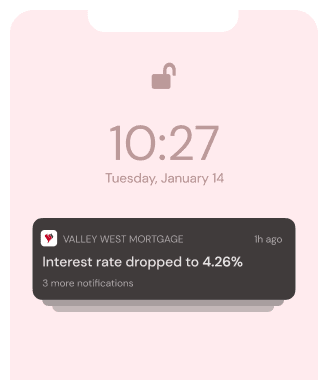
Here is the standard we hold ourselves to on every purchase file. First, when the application is complete, both you and your buyer get a confirmation and a clear document list. Then, at each milestone that follows — disclosures out, appraisal ordered, appraisal received, conditional approval, conditions cleared, clear to close, and funding — we reach out to both of you proactively. Additionally, you choose the channel: call, text, or email. If something threatens the contract dates, you hear about it from us first, with options, not after the fact.
Just as important, you get a person, not a portal. Your files sit with a licensed Las Vegas loan officer who answers the phone, works the file locally, and knows what a weekend of back-and-forth costs an agent in this market. For instance, when a negotiation could use structure — say, seller-paid closing costs doing real work in a soft week — your loan officer flags it while the offer is still being written, not after acceptance.
What stands behind our pre-approval letters?
A pre-approval letter is only as good as the verification behind it. Ours follow a stated standard, and we hold to it even when a buyer is in a hurry. Specifically, before a Valley West pre-approval letter goes out:
- We pull credit. A real credit report, not a stated score. The file prices off what the report actually says.
- We review income documents. Paystubs and W-2s for wage earners; tax returns for self-employed buyers. We read them before we commit to a number.
- We review asset documents. Funds to close have to exist and be usable. We read the bank statements, and we paper gift funds correctly from the start.
- A licensed loan officer reviews the file. The letter reflects a professional's judgment about the whole picture, not an online form's arithmetic.
That's the whole trick behind on-schedule closings: we find the surprises before the letter, not during escrow. Because we document the file up front, the underwriter mostly confirms what we already verified. Our pre-approval guide walks through the document list step by step, and our companion piece on what underwriters check shows listing agents where weak files usually crack. Send either one to a buyer who wants to understand the process.
Which buyers can you send us?
Almost any serious one. Product breadth is the quiet workhorse of an agent partnership. When one program says no, a shop that only writes that program loses your buyer — whereas we re-route the same file. Here's the placement map:
| Program | Buyer profile | What agents should know |
|---|---|---|
| FHA | First-time buyers, smaller savings, rebuilding credit | Forgiving entry requirements; a tight, documented FHA pre-approval competes far better than its reputation suggests |
| VA | Veterans, active-duty service members, eligible surviving spouses | Strong terms for the buyer; the program rewards agents who understand its appraisal and inspection rhythm |
| Conventional | Established credit and savings; also second homes and rentals | The market's default; strongest fit for well-qualified buyers and clean, fast files |
| DSCR | Real-estate investors buying rental property | Qualifies on the property's rental cash flow rather than personal tax returns — business-purpose loans for investment properties only, never a primary residence |
The DSCR lane deserves a special mention, because it rescues a specific deal agents know well: the self-employed investor whose tax returns understate real cash flow. On a DSCR file, the property's rent does the qualifying. We cover the mechanics in DSCR files for your investor clients on our conventional-loans site. One investor case deserves its own note: an exchanger buying a replacement property runs a statutory deadline, so we scope those files against the 45-day and 180-day exchange clocks before the offer goes out. Furthermore, we price every program above from a single file and a single credit pull — that's real program breadth working in your buyer's favor.
Have a buyer who doesn't fit the box?
Run the scenario past a local loan officer before you write the offer. Call (702) 696-9900 or reach out online.
Start the ConversationHow do we co-market without RESPA problems?
This section exists because the wrong answer can cost you your license. The Real Estate Settlement Procedures Act — RESPA — governs how agents and mortgage companies work together, and Section 8 of the act is the hard wall. We treat it as one, openly, and we think that makes us the safer partner.
What Section 8 actually prohibits
In plain English: under RESPA Section 8, codified at 12 U.S.C. § 2607, no one may give or accept a fee, kickback, or thing of value in exchange for referring settlement-service business on a federally related mortgage. That covers cash, obviously. It also covers disguised versions — above-market "advertising" payments, lavish gifts, event tickets tied to volume. Moreover, the implementing regulation, 12 CFR § 1024.14, states flatly that a referral is not a compensable service. Regulators can and do treat any payment above fair market value as a disguised referral fee.
So our position is simple: we do not pay referral fees, and we do not accept them. Not as cash, not as gifts, not as anything of value tied to business sent our way. Any mortgage company that offers you one is offering you shared liability.
What compliant co-marketing looks like
The same law leaves room for legitimate joint marketing, because paying fair value for actual goods and services is expressly permitted. Consequently, here's what we happily do with agent partners, always at documented fair market value:
- Shared advertising — a joint ad, mailer, or listing flyer where each party pays the fair-market share of its own space, documented in writing.
- Co-hosted events — homebuyer seminars or open-house support where costs split according to the value each side actually receives.
- Educational content — co-branded guides for your clients, with each side paying its own way.
And one more guardrail that protects everyone: no steering. Your client always chooses their own lender. We never ask you to require us, and nothing about a co-marketing arrangement ever depends on how many files you send. That is the arrangement RESPA envisions, and it's the only one we'll enter.
Valley West takeA mortgage partner who is casual about RESPA is a liability with your name on it. The partners worth having are the ones who tell you no when a structure crosses the line — because the same discipline that protects our license protects yours. We'd rather lose a co-marketing idea than hand either of us a compliance problem. Twenty years in this market taught us that the boring, documented, fair-market-value way is also the durable way.
Why partner with an independent Las Vegas mortgage lender who's been here since 2004?
Because your reputation rides on every vendor you recommend, and track records are checkable. Valley West Mortgage has operated from Las Vegas since 2004 — through the boom, the crash, and everything after. Today our clients rate us 4.7 stars across 525+ Google reviews, alongside 860+ reviews on Birdeye. Read them: the pattern agents care about is right there — communication, responsiveness, closings that happened when they were supposed to.
The local part matters operationally, too. Our loan officers work where your listings are, from our office at 8010 W Sahara Ave, Suite 140. They know the valley's HOA quirks, its appraisal turn realities, and its escrow customs. Additionally, Valley West is licensed in 32+ states and D.C., so when your client's out-of-state relative wants the same treatment, the answer is usually yes. And because we are not tied to a single investor's appetite, one underwriting overlay never becomes your transaction's dead end.
How does the partnership start?
No contracts, no commitments, no volume expectations. It starts the way good working relationships do:
Step 1 — Reach out. Use the contact page or call (702) 696-9900. Tell us about your business and how you like to receive updates.
Step 2 — Meet your loan officer. You get a direct line to a licensed local loan officer — not a queue. Use them as a scenario desk: pricing questions before a listing appointment, program fit before an offer, structure ideas when a negotiation stalls.
Step 3 — Send one file and judge us on it. No partnership pitch beats a clean escrow. Watch how the updates land, how the letter holds up, and how the closing tracks the contract. Then decide what we are to your business.
Your buyer applies → you and the buyer both get confirmation plus the document list. We pull credit and review the documents → the pre-approval decision reaches you directly. The offer is accepted → we map the loan milestones against the contract dates. From there, every milestone — disclosures, appraisal, conditional approval, clear to close, funding — arrives as a proactive update to you and your client, in the channel you chose. This cadence is illustrative of our standard, not a promise of specific dates on any individual file.
Prefer to start in writing?
The note below reaches a licensed Las Vegas loan officer directly. It takes about a minute. Notice what it does not ask: nothing about how much business you send anyone, because that is not what this relationship is built on.
Thanks — your note is in.
A licensed Valley West loan officer will reply to you directly. If you would rather talk it through now, call (702) 696-9900.
Agent partnership FAQ
Do you pay referral fees to real-estate agents?
No — and no legitimate mortgage company does. RESPA Section 8 (12 U.S.C. § 2607) prohibits giving or accepting anything of value in exchange for settlement-service referrals. What we offer instead is a partner whose communication, verification standard, and product breadth make you look good in front of your clients.
How will you keep me updated on my client's loan?
Proactively, at every milestone: application complete, disclosures out, appraisal ordered and received, conditional approval, conditions cleared, clear to close, and funding. Updates go to you and your client at the same time, by call, text, or email — whichever you prefer. If a problem threatens the timeline, you hear it from us first, with options.
What has to happen before you issue a pre-approval letter?
We pull credit, we review income and asset documents, and a licensed loan officer evaluates the whole file. We don't issue letters on stated numbers alone. That verification discipline is why our letters hold up in escrow and why closings are more likely to stay on schedule.
More partnership questions
Can you handle FHA and VA offers?
Yes — both are core programs here, and we've arranged them in Las Vegas since 2004. A documented FHA or VA pre-approval competes far better than the programs' reputations suggest, and our loan officers help agents present those offers with proof instead of apologies.
What about investor clients who don't qualify on tax returns?
That's the DSCR lane. A DSCR loan qualifies on the property's rental cash flow rather than the borrower's personal income documents. These are business-purpose loans for investment properties only — never for a primary residence — and they keep self-employed investors in your pipeline.
Do I have to send you every client?
No. There's no exclusivity, no quota, and no strings — RESPA's no-steering principle is one we take seriously in both directions. Your client always chooses their own lender. We simply aim to be the call you want to make.
The bottom line
A mortgage partnership is worth exactly what it does for your transactions. Ours offers four concrete things: milestone communication to you and your client on every file, pre-approval letters backed by pulled credit and reviewed documents, the product breadth to place FHA, VA, conventional, and DSCR buyers, and a co-marketing posture that keeps RESPA Section 8 between both our licenses and trouble. We've done this from Las Vegas since 2004, and the reviews tell the story. The next step costs you one conversation — and your next hard file is a fine place to start it.
Sources
- 12 U.S.C. § 2607 — Real Estate Settlement Procedures Act, Section 8: prohibition against kickbacks and unearned fees: uscode.house.gov
- 12 CFR § 1024.14 (Regulation X) — no referral fees; referrals are not compensable services; fair-market-value standard for payments: ecfr.gov
- CFPB — Real Estate Settlement Procedures Act FAQs (Section 8 topics, including gifts, promotional activity, and marketing services agreements): consumerfinance.gov
- CFPB — What's the difference between a prequalification letter and a preapproval letter?: consumerfinance.gov
Across Valley West: Send buyers straight to the guide that fits their program: VA financing for your veteran buyers on our dedicated VA site, what FHA buyers qualify for in Clark County on our FHA site, and the conventional route for well-qualified buyers on our conventional site.
Keep reading
Last updated: July 20, 2026 — new agent-partnership hub: the milestone communication standard, the pre-approval verification standard (credit pulled, income and asset documents reviewed), the FHA/VA/conventional/DSCR placement map, and the RESPA Section 8 co-marketing rules in plain English (12 U.S.C. § 2607; 12 CFR § 1024.14); sourced to the U.S. Code, the eCFR, and the CFPB.